
Hand Safety: The Most Injured Body Part in Industry
Total Group of Companies
In the complex landscape of modern industry, hands are the most injured body part requiring comprehensive protection strategies. Facilities across North America face unique challenges that require specialized knowledge and proactive strategies. Understanding how to prevent hand injuries is not just about regulatory compliance; it is about protecting the workforce, safeguarding valuable assets, and ensuring business continuity. Total Group of Companies has spent years developing expertise in this critical area, recognizing that a comprehensive approach is the only way to mitigate hand injury risks effectively. This article explores the fundamental principles, current best practices, and future trends that every industrial leader needs to know.
The Core Principles and Operational Impact
At the heart of hand safety lies a set of core principles that dictate how industrial facilities should approach protection from hand injuries. Hazard identification must be thorough. Hand protection must be appropriate. Engineering controls must be prioritized. Administrative procedures must be established. Worker training must be comprehensive. Incident investigation must be systematic.
When these principles are applied correctly, they create a robust framework that prevents hand injuries before they occur. The operational impact of a well designed hand safety program cannot be overstated. Facilities that prioritize these elements consistently report fewer hand injuries, reduced workers compensation costs, lower insurance premiums, and higher employee morale. It requires a deep understanding of the specific hand hazards present in the environment and the deployment of targeted solutions to address them.
The most successful organizations integrate hand safety into their daily routines, making hand protection an inherent part of the production process rather than an afterthought. This integration includes systematic hazard assessment, appropriate glove selection, engineering controls, administrative procedures, comprehensive training, and incident investigation.
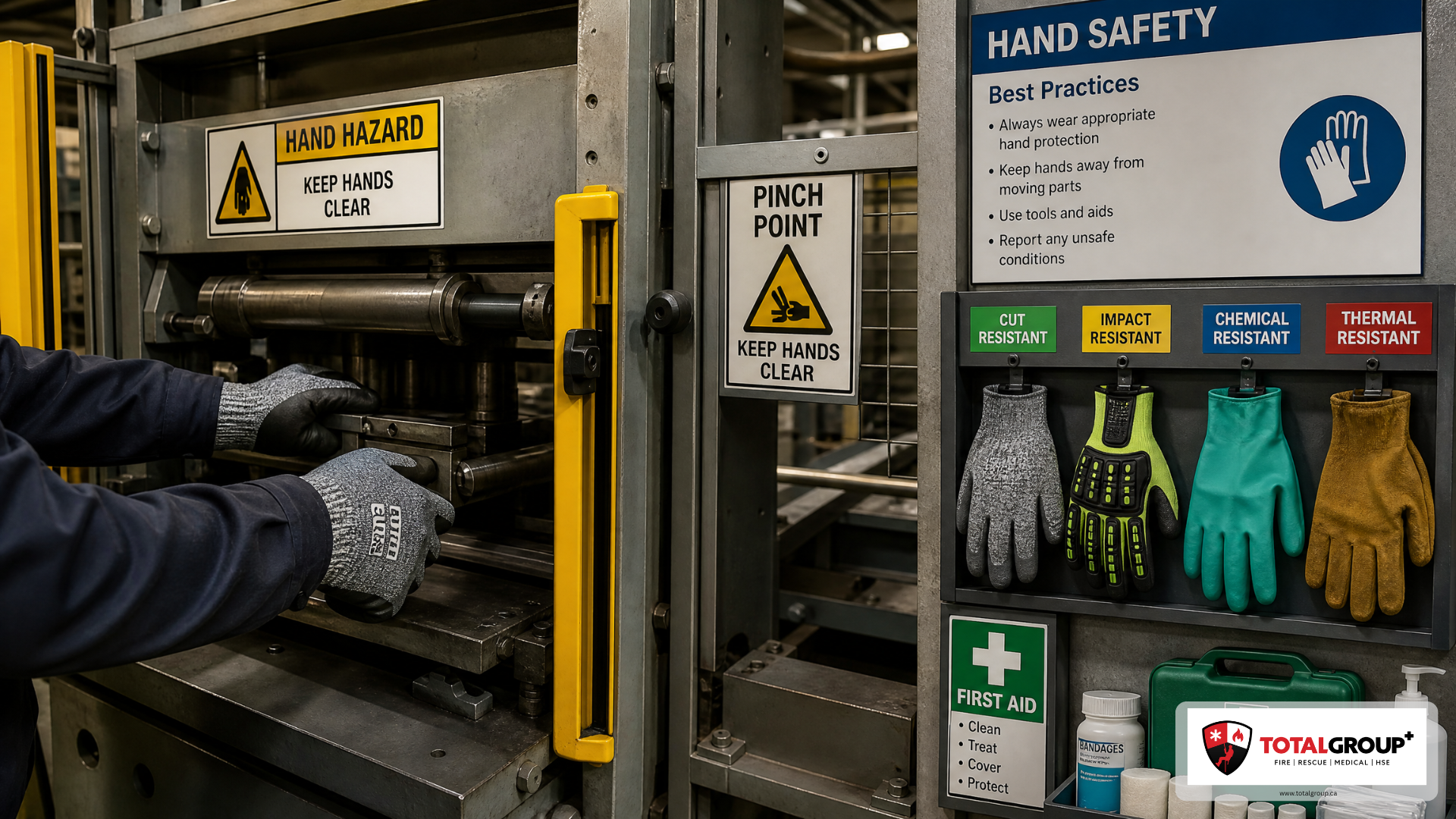
Hand hazards include pinch points, cutting surfaces, abrasion hazards, puncture hazards, thermal hazards, and chemical hazards. Pinch points occur at machinery joints and moving parts. Cutting surfaces include sharp edges and blades. Abrasion hazards occur from rough surfaces and friction. Puncture hazards include nails and sharp objects. Thermal hazards include hot surfaces and flames. Chemical hazards include corrosive and toxic substances. Each hazard type requires different protection approaches.
Hand protection equipment includes cut resistant gloves, impact resistant gloves, chemical resistant gloves, thermal gloves, and puncture resistant gloves. Cut resistant gloves protect against sharp edges and blades. Impact resistant gloves protect against crushing and impact injuries. Chemical resistant gloves protect against corrosive and toxic substances. Thermal gloves protect against heat and cold. Puncture resistant gloves protect against sharp objects. Selection depends on hazard type, intensity, and duration of exposure.
Engineering controls reduce hand injury hazards at the source. Machine guards prevent access to moving parts. Interlocked gates stop machinery when opened. Automated systems reduce manual handling. Tool design improvements reduce hand strain. Workstation design improvements reduce hand hazards. Engineering controls are the most effective approach to hand injury prevention.
Navigating Regulatory Standards and Compliance
Compliance with industry standards is a foundational element of hand safety programs. Regulatory bodies such as OSHA, NFPA, and provincial health and safety organizations including WorkSafeBC and provincial occupational health and safety agencies continuously update their guidelines to reflect new research and evidence. Staying ahead of these changes is a significant challenge for facility managers.
OSHA requires that employers provide appropriate personal protective equipment including hand protection. OSHA requires hazard assessment to identify hand hazards. OSHA requires engineering controls to eliminate or reduce hand hazards. OSHA requires training on hand protection selection and use. OSHA requires incident investigation and reporting. In Canada, WorkSafeBC and provincial occupational health and safety regulations establish requirements for hand safety programs. The Canadian Centre for Occupational Health and Safety (CCOHS ) provides guidance on hand safety program implementation. CSA Z96 Standard for Protective Gloves establishes Canadian standards for glove selection and use.
A proactive compliance strategy involves regular audits, continuous training, and a commitment to exceeding minimum requirements. By aligning operational practices with the latest standards, companies not only avoid costly penalties but also demonstrate genuine commitment to the well being of their personnel. This includes maintaining written hand safety programs, documenting all hazard assessments, maintaining training records, and maintaining incident investigation records. Organizations should conduct annual compliance reviews to ensure that all hand safety systems meet the highest industry benchmarks.
Hand safety programs must include training for all personnel. Personnel must understand hand hazards in their work areas. Personnel must know hand protection selection and use. Personnel must understand maintenance and storage of hand protection. Personnel must know when hand protection is required. Personnel must understand incident reporting procedures. Training must be documented and refreshed annually. Organizations should maintain records of all personnel who have received hand safety training.
Implementing Effective Solutions in the Field
The transition from theory to practice is often the most difficult phase of implementing hand safety programs. Implementing effective solutions requires a combination of the right equipment, specialized training, and a culture that supports continuous improvement. Field implementation must be tailored to the specific needs of the site, taking into account factors such as facility layout, workforce demographics, production schedules, and specific hand hazards.
Effective field implementation includes several key components. First, conduct comprehensive hand hazard assessment. Second, implement engineering controls. Third, select appropriate hand protection. Fourth, provide training. Fifth, conduct incident investigation.
Hazard assessment procedures must identify all hand hazards. Assessment must evaluate hazard severity and frequency. Assessment must determine appropriate protection levels. Assessment must be documented and updated when processes change. Assessment results determine engineering control priorities and hand protection needs.
Engineering control procedures must prioritize hazard elimination at the source. Controls must be evaluated for effectiveness. Controls must be installed and maintained properly. Controls must be documented with hazard reduction measurements. Controls must be reviewed when equipment changes. Effective engineering controls reduce or eliminate hand protection needs.
Hand protection procedures must ensure proper selection and use. Selection must match hazard types and intensities. Fit testing must ensure proper fit and comfort. Training must cover proper donning and doffing. Maintenance must include cleaning and inspection. Replacement must occur when protection is damaged. Proper use ensures adequate protection.
Training procedures must ensure all workers understand hand safety. Training must cover hazard identification. Training must cover protection selection and use. Training must cover incident reporting. Training must include practical exercises. Training must be documented and refreshed annually.
Incident investigation procedures must identify root causes. Investigation must determine what happened and why. Investigation must identify contributing factors. Investigation must recommend corrective actions. Investigation must be documented and tracked. Investigation results must guide program improvements.
Conclusion
Addressing the challenges associated with hand safety is an ongoing process that demands vigilance, expertise, and a commitment to excellence. As industrial environments continue to evolve and equipment continues to pose hand hazards, so too must the strategies used to protect workers. By focusing on core principles of hazard elimination and hand protection, maintaining strict regulatory compliance, and implementing tailored hand safety programs in the field, organizations can create a safer, more resilient operation. The investment in comprehensive hand safety programs today pays dividends in reduced hand injuries, improved worker health, enhanced safety culture, and improved operational performance.
Ready to strengthen your hand safety program? Contact Total Group of Companies today at www.totalgroup.ca to learn how our expert teams can support your operations.
References
1. Occupational Safety and Health Administration (OSHA). Hand and Finger Protection Standards. Washington, DC: Department of Labor, 2023.
2. Canadian Centre for Occupational Health and Safety (CCOHS). Hand Protection. Hamilton, ON: CCOHS, 2023.
3. WorkSafeBC. Hand Safety Requirements. Victoria, BC: Province of British Columbia, 2023.
4. Canadian Standards Association (CSA). Z96 Standard for Protective Gloves. Toronto, ON: CSA, 2023.
5. National Fire Protection Association (NFPA). NFPA 1500 Standard on Fire Department Occupational Safety and Health Program. Quincy, MA: NFPA, 2023.
6. National Institute for Occupational Safety and Health (NIOSH). Hand Safety. Cincinnati, OH: NIOSH, 2023.
7. International Organization for Standardization (ISO). ISO 13997 Protective Gloves Against Mechanical Risks. Geneva, Switzerland: ISO, 2023.
8. American Society of Safety Professionals (ASSP). Hand Safety Best Practices. Des Plaines, IL: ASSP, 2023.