



The Importance of CPO-Approved Working at Heights Training in Ontario
Total Group of Companies
Under Ontario’s construction-project rules, employers must ensure affected workers have valid fall-protection training before they use a listed method. The Ontario training route requires successful completion of a Working at Heights program approved by the Chief Prevention Officer and delivered by an approved provider. The regulation also recognizes specified Newfoundland and Labrador training and includes a limited exemption, explained below. Employers must also provide adequate instruction on the fall-protection system the worker may use at that project.1 2
Who needs approved Working at Heights training in Ontario?
The requirement applies under Ontario Regulation 297/13 to workers who are required under the Construction Projects Regulation to use a travel restraint system, fall restricting system, fall arrest system, safety net, work belt, or safety belt.1 Ontario’s Ministry of Labour, Immigration, Training and Skills Development describes this as a requirement for workers on construction projects who use fall-protection devices.3
Ontario also accepts the fall-protection training prescribed under Newfoundland and Labrador’s Occupational Health and Safety Regulations, 2012 while the WorkplaceNL certificate remains valid. Section 7 also includes a limited exemption for workers directly employed by an automobile manufacturer or assembler that owns and operates a specified automotive workplace. Employers should check the full conditions in subsections 7(3) and (4) before relying on that exemption.1 3
A worker is not automatically covered simply because the job is elevated, and a Working at Heights record is not a complete answer for every workplace. The regulation connects the requirement to work on a construction project and to the listed methods of fall protection.1 Workplaces outside the Construction Projects Regulation can still have occupational health and safety duties, equipment requirements, and hazards that need to be assessed under the rules that apply to that work. Employers should determine the applicable requirements before assigning the task.3
For hazards covered by section 26, Ontario’s Construction Projects Regulation sets the order of fall protection. Where a guardrail cannot practicably be installed, the worker must be protected by the highest-ranked practicable method, beginning with travel restraint, then fall restricting, fall arrest, and safety nets.2 Training supports that decision-making, but it does not make an unsuitable access method or poorly planned task safe.
What “CPO-approved” means
For an Ontario Working at Heights program to meet the regulation, the program must be approved by the Chief Prevention Officer against the applicable program standard, and the provider must be approved against the applicable provider standard.1 The Ministry’s provider standard explains that providers must demonstrate that they meet both standards to deliver an approved program.4
When choosing training, check the provider rather than relying on a logo, advertisement, or informal card. Ontario publishes information on approved providers and advises employers to confirm that the provider was approved when the worker completed the training.3 The Ministry has also warned that unapproved providers may issue cards that will not be accepted as valid proof of training.5
For Ontario training, section 10 requires a record containing the worker’s name, the approved provider’s name, the approved program’s name, and the successful-completion date. A copy of the worker’s CPO-issued proof of completion counts as that record.1 Ontario’s guidance also permits an employer to check training validity using proof of completion from an approved provider. With the worker’s consent, the employer can verify the worker’s information through the Ministry’s certification management system or contact the Ministry to confirm validity.3
What the approved program covers
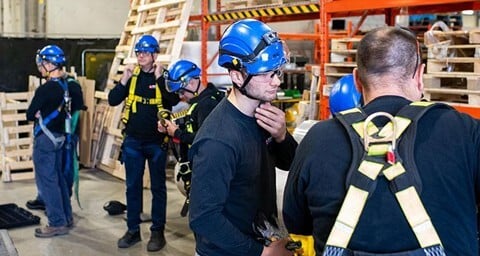
Ontario’s Working at Heights Training Program Standard has two modules. The Basic Theory Module covers roles, rights, and responsibilities; hazard recognition; the hierarchy of controls; warning methods and physical barriers; barriers and safety nets; and ladder safety. The Practical Module covers fall-protection systems, personal fall-protection equipment, anchor points, work positioning systems, ladders, work access and platforms, and rescue planning.6
A learner must successfully complete Basic Theory before taking the Practical Module.6 In the practical learning outcomes, the standard addresses the limits and application of restraint, fall restricting, and fall-arrest systems, inspection of common personal fall-protection equipment, fall clearance, and maintaining tie-off while changing anchor points.6
These are minimum standardized learning outcomes, not a substitute for planning a particular job. A crew may have valid training and still need further instruction for the access method, anchor arrangement, equipment model, weather conditions, work around openings, or rescue arrangements at the worksite.4 6 The checklist below helps employers plan training and instruction checks; it does not specify a fall-protection system design, equipment setup, or rescue procedure.
Standardized training does not replace site- and equipment-specific instruction
Ontario Regulation 213/91 requires an employer to ensure that a worker who may use a fall-protection system is adequately trained in its use and receives adequate oral and written instructions from a competent person. The regulation states that this duty is in addition to the Working at Heights training requirement.2
Before a worker uses a system, the employer should ensure the worker understands the system selected for the task, the limitations of the equipment, the intended anchor arrangement, the work sequence, and the site controls. If a fall-arrest system or safety net will be used, the employer must develop written procedures for rescuing a worker after a fall has been arrested before the system is used.2
Employers also need a record of the system-specific training and instruction. The record must identify the worker and the dates of the training and instruction, be signed by the person who provided it, and be available to an inspector on request.2 Keeping the approved Working at Heights record and the equipment-specific instruction record together makes it easier to confirm what training was completed and what was addressed for the job.
How long is Working at Heights training valid?
An approved Ontario Working at Heights training program is valid for three years from the date of successful completion.1 Ontario’s guidance and program standard require successful completion of approved refresher training to renew validity for another three years. Eligibility for refresher training depends on having previously successfully completed both modules of an approved Working at Heights program.3 6
A straightforward renewal process starts with a current training register. Record the worker’s successful-completion date, the provider and program names, and the expiry date and planned refresher date. Check the record and confirm validity before scheduling the worker for a task that may require a listed method of fall protection.
A practical employer checklist before height-related work begins
- Confirm the work context. Determine whether the job is a construction project and whether the worker may use one of the listed fall-protection methods. Check whether the accepted Newfoundland and Labrador training route or the limited automotive-worker exemption applies.1
- Verify standardized training. For Ontario training, confirm that the program and provider were approved when the worker completed the course, and that the training has not expired. For the accepted Newfoundland and Labrador alternative, check the valid WorkplaceNL Fall Protection certificate.1 3
- Keep the required record. For Ontario training, retain the CPO-issued proof of completion or a record with the required program, provider, worker, and successful-completion date information. For the Newfoundland and Labrador alternative, retain a copy of the WorkplaceNL certificate. Make the record available if requested by an inspector.1 3
- Provide competent-person instruction for the actual system. Address the system, equipment, and instructions the worker may use at the project, and document that instruction.2
- Check the selected protection method. Apply the guardrail requirement and the hierarchy of practicable fall-protection methods where section 26 applies.2
- Prepare for a fall. Where a fall-arrest system or safety net will be used, develop the written rescue procedures required before use.2
Plan the training requirement before the work is assigned
Before assigning work, match the training record to the worker, confirm the applicable training route, check the expiry date, and address the site-specific system and rescue arrangements.
Discuss training requirements for your team
Frequently asked questions
Is CPO-approved Working at Heights training required for every person working above ground?
No. Under Ontario Regulation 297/13, the training requirement applies to workers required under the Construction Projects Regulation to use specified methods of fall protection. The regulation also accepts specified Newfoundland and Labrador training and includes a limited automotive-worker exemption. The Ministry notes that workers whose workplaces are not covered by the Construction Projects Regulation do not have to complete Ontario’s approved Working at Heights training, although other workplace obligations may still apply.1 3
Does an Ontario Working at Heights card remain valid when a worker changes employers?
Ontario states that a worker does not need to complete another approved program when changing employers if the training remains valid. The new employer is still responsible for confirming validity and providing any required equipment- and site-specific instruction.3
Does the standardized course replace training on the fall-protection equipment at the job site?
No. The Construction Projects Regulation requires training in the use of the fall-protection system and adequate oral and written instruction from a competent person, in addition to the Working at Heights training requirement.2
What should an employer keep as proof of Working at Heights training?
For Ontario Working at Heights training, section 10 requires a record containing the worker’s name, the approved provider’s name, the approved program’s name, and the successful-completion date. A copy of the worker’s CPO-issued proof of completion counts as that record. The record must be available to a Ministry inspector on request.1 3
Sources
- Ontario Regulation 297/13: Occupational Health and Safety Awareness and Training. Sections 6 to 10 set out the training application, Ontario program and provider approval requirements, the accepted Newfoundland and Labrador alternative, the limited automotive-worker exemption, validity periods, additional Construction Projects Regulation duties, and training-record requirements.
- Ontario Regulation 213/91: Construction Projects. Sections 26, 26.1 and 26.2 address fall hazards, the hierarchy of fall-protection methods, written rescue procedures, and system-specific training and instruction.
- Training for working at heights, Government of Ontario. Government overview of affected workers, provider verification, proof of training, refresher eligibility, employer duties, records, and accepted Newfoundland and Labrador training.
- Provider standard for working at heights training, Government of Ontario. Explains the approvals required for providers delivering an approved Working at Heights program.
- Alert: fraudulent working at heights training cards, Government of Ontario. January 2026 alert on verifying provider approval and valid training records.
- Program standard for working at heights training, Government of Ontario. Sets out the Basic Theory and Practical modules, their sequence, mandatory learning outcomes, and refresher requirements.