Virtual Reality in Safety Training: Promise, Limitations, and Best Practices
Total Group of Companies
In the complex landscape of modern industry, virtual reality enhances safety training with immersive scenarios that boost learning and retention. Facilities across North America face unique challenges that require specialized knowledge and proactive strategies. Understanding how to implement virtual reality training is not just about regulatory compliance; it is about protecting the workforce, safeguarding valuable assets, and ensuring business continuity. Total Group of Companies has spent years developing expertise in this innovative area, recognizing that a comprehensive approach is the only way to mitigate risks effectively. This article explores the fundamental principles, current best practices, and future trends that every industrial leader needs to know.
The Core Principles and Operational Impact
At the heart of virtual reality in safety training lies a set of core principles that dictate how industrial facilities should approach immersive learning. Realistic scenario simulation improves learning. Repeated practice builds muscle memory. Safe failure allows learning without consequences. Immediate feedback reinforces correct behaviors. Measurable performance tracking shows progress. Scalable training reaches many workers efficiently.
When these principles are applied correctly, they create a robust framework that prevents incidents before they occur. The operational impact of a well designed virtual reality safety training program cannot be overstated. Facilities that prioritize these elements consistently report higher knowledge retention, improved skill development, reduced incident rates, lower insurance premiums, and higher employee engagement. It requires a deep understanding of worker learning needs and the deployment of targeted virtual reality strategies to address them.
The most successful organizations integrate virtual reality into their training routines, making safety learning immersive and memorable rather than passive and forgettable. This integration includes realistic scenario simulation, repeated practice opportunities, safe failure environments, immediate feedback systems, and performance tracking.
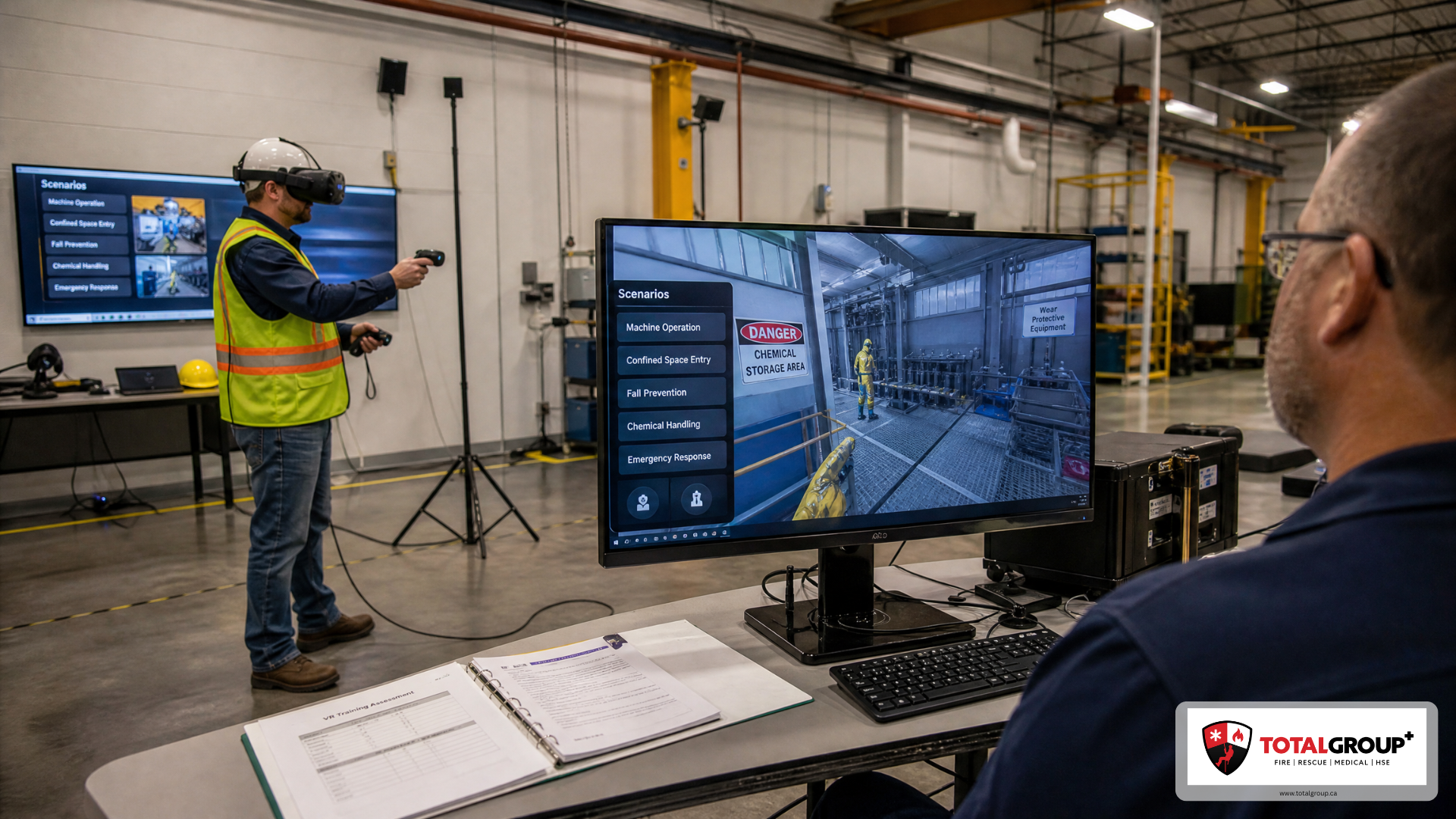
Virtual reality training scenarios include machinery operation, confined space entry, fall prevention, chemical handling, and emergency response. Machinery operation scenarios teach safe equipment operation and hazard recognition. Confined space entry scenarios teach entry procedures and atmospheric monitoring. Fall prevention scenarios teach proper harness use and fall arrest procedures. Chemical handling scenarios teach proper protection and spill response. Emergency response scenarios teach evacuation procedures and incident response. Each scenario type addresses specific workplace hazards.
Virtual reality advantages include realistic scenario simulation, safe failure environment, repeated practice opportunities, consistent training delivery, and measurable performance tracking. Realistic scenarios improve learning transfer to actual work. Safe failure allows workers to make mistakes without real consequences. Repeated practice builds confidence and competence. Consistent delivery ensures all workers receive identical training. Performance tracking identifies knowledge gaps and training needs.
Virtual reality limitations include equipment costs, technical requirements, motion sickness potential, and training design complexity. Equipment costs can be significant for initial setup. Technical requirements include computers, headsets, and software. Motion sickness affects some users during extended use. Training design requires specialized expertise. Understanding limitations helps organizations make informed implementation decisions.
Navigating Regulatory Standards and Compliance
Compliance with industry standards is a foundational element of virtual reality safety training programs. Regulatory bodies such as OSHA, NFPA, and provincial health and safety organizations including WorkSafeBC and provincial occupational health and safety agencies continuously update their guidelines to reflect new research and evidence. Staying ahead of these changes is a significant challenge for facility managers.
OSHA requires that employers provide safety training. OSHA requires training to be documented. OSHA requires training effectiveness to be assessed. OSHA requires training to be updated when hazards change. OSHA does not prohibit virtual reality if training meets all requirements. In Canada, WorkSafeBC and provincial occupational health and safety regulations establish requirements for safety training programs. The Canadian Centre for Occupational Health and Safety (CCOHS ) provides guidance on safety training program implementation. CSA standards establish requirements for training content and delivery.
A proactive compliance strategy involves regular audits, continuous training, and a commitment to exceeding minimum requirements. By aligning operational practices with the latest standards, companies not only avoid costly penalties but also demonstrate genuine commitment to the well being of their personnel. This includes maintaining documented training programs, tracking training completion, assessing training effectiveness, and maintaining training records. Organizations should conduct annual compliance reviews to ensure that all virtual reality training systems meet the highest industry benchmarks.
Virtual reality training programs must maintain compliance with all regulatory requirements. Training content must cover all required topics. Training must be documented with completion records. Training effectiveness must be assessed and tracked. Training must be updated when hazards change. Training records must be maintained for audit purposes. Virtual reality enhances compliance by improving learning outcomes and retention.
Implementing Effective Solutions in the Field
The transition from theory to practice is often the most difficult phase of implementing virtual reality safety training programs. Implementing effective solutions requires a combination of the right technology, specialized training design, and a culture that supports continuous improvement. Field implementation must be tailored to the specific needs of the facility, taking into account factors such as facility layout, workforce demographics, production schedules, and existing safety culture.
Effective field implementation includes several key components. First, assess training needs. Second, evaluate virtual reality options. Third, design training scenarios. Fourth, implement and pilot. Fifth, monitor and improve.
Assessment procedures must identify specific training needs. Assessment must evaluate current training effectiveness. Assessment must identify knowledge gaps. Assessment must determine worker learning preferences. Assessment must assess technical readiness. Assessment results guide virtual reality strategy development.
Evaluation procedures must assess available virtual reality platforms. Evaluation must consider equipment costs and technical requirements. Evaluation must assess scenario availability and customization options. Evaluation must evaluate ease of use and user support. Evaluation must include pilot testing with actual workers. Appropriate platform selection ensures successful implementation.
Scenario design procedures must create realistic training environments. Design must include realistic hazards and consequences. Design must provide clear learning objectives. Design must include performance feedback systems. Design must allow repeated practice. Design must track learner progress. Quality scenario design drives learning outcomes.
Implementation procedures must include change management. Implementation must include user training on equipment. Implementation must include pilot testing with feedback. Implementation must include performance assessment. Implementation must include documentation and record keeping. Implementation must include ongoing support and updates. Structured implementation ensures successful adoption.
Monitoring procedures must track training effectiveness. Monitoring must measure completion rates. Monitoring must assess knowledge retention. Monitoring must track behavior change on the job. Monitoring must measure incident reduction. Monitoring must include worker feedback. Continuous monitoring guides improvements.
Conclusion
Addressing the challenges associated with virtual reality safety training is an ongoing process that demands vigilance, expertise, and a commitment to excellence. As industrial environments continue to evolve and virtual reality technology continues to advance, so too must the strategies used to deliver safety training. By focusing on core principles of immersive learning and realistic practice, maintaining strict regulatory compliance, and implementing tailored virtual reality strategies in the field, organizations can create safer, more resilient operations. The investment in virtual reality safety training programs today pays dividends in improved learning outcomes, better knowledge retention, reduced incidents, improved safety culture, and improved operational performance.
Ready to strengthen your safety training program? Contact Total Group of Companies today at www.totalgroup.ca to learn how our expert teams can support your operations.
References
1. Occupational Safety and Health Administration (OSHA). Safety and Health Training Requirements. Washington, DC: Department of Labor, 2023.
2. Canadian Centre for Occupational Health and Safety (CCOHS). Training and Education. Hamilton, ON: CCOHS, 2023.
3. WorkSafeBC. Training and Education Requirements. Victoria, BC: Province of British Columbia, 2023.
4. Canadian Standards Association (CSA). Z1000 Occupational Health and Safety Management. Toronto, ON: CSA, 2023.
5. National Fire Protection Association (NFPA). NFPA 1500 Standard on Fire Department Occupational Safety and Health Program. Quincy, MA: NFPA, 2023.
6. National Institute for Occupational Safety and Health (NIOSH). Training and Education. Cincinnati, OH: NIOSH, 2023.
7. International Organization for Standardization (ISO). ISO 45001 Occupational Health and Safety Management Systems. Geneva, Switzerland: ISO, 2023.
8. American Society of Safety Professionals (ASSP). Virtual Reality Training Best Practices. Des Plaines, IL: ASSP, 2023.