


Fire Pump Testing and Maintenance: Keeping Your System Ready
Total Group of Companies
A fire pump needs more than a yearly appointment on a calendar. The facility team needs a site-specific program that checks how the pump starts and runs, records test results, and tracks deficiencies through correction and return to service. The program should follow the fire code and standards adopted for the building, the manufacturer’s instructions, the approved fire-safety plan, and direction from the authority having jurisdiction. NFPA standards and public guidance do not by themselves establish the legal requirements for a Canadian building. This overview helps facility teams plan testing; it does not replace the qualified tester’s procedure for the installed equipment.
Fire pumps are used in many water-based fire protection systems when the available water source cannot provide enough pressure for the system it serves.[3] NFPA describes NFPA 20 as the standard for the selection and installation of stationary fire pumps, while NFPA 25 addresses the inspection, testing, and maintenance of water-based fire protection systems.[1] [2]
What does a fire pump test need to prove?
A fire pump is part of a fire protection water supply, so the test program should focus on readiness for the fire system it supports. That means checking how the pump starts and runs, recording readings and equipment conditions, and investigating unexpected results.
The testing method must match the installation. NFPA’s 2022 public guidance describes a no-flow test, often called a churn test, conducted weekly or monthly under NFPA 25 depending on the pump type, driver, and permitted risk-analysis allowances. Do not copy an interval from another facility. Confirm the applicable edition, local adoption, equipment configuration, and any approved alternatives before setting the schedule.[3] Ontario’s Fire Code, for example, has its own fire-pump operating and testing provisions and a clause recognizing compliance with NFPA 25’s fire-pump inspection, testing and maintenance provisions. A monthly interval from a general article is not enough to establish the schedule for an Ontario building.[4]
Before any test, confirm who owns the process. The responsible person should know the pump’s driver type, controller arrangement, water source, normal operating information, last test result, open deficiencies, and who must be notified if the equipment cannot be returned to service. Keep the approved procedure at the test location or in the work package. A rushed test conducted from memory can miss a changed condition or produce a record that is hard to interpret later.
How should a no-flow test be approached?
A no-flow test checks starting and running behaviour without measuring flow at the pump’s rated capacity. NFPA’s 2022 public guidance describes checking automatic starting. The qualified tester should use the installed controller’s instructions and the site procedure to confirm the correct test function and starting method. Manual starting alone does not establish that automatic starting works. Other controller arrangements and permitted automated methods need their own applicable procedure.[3]
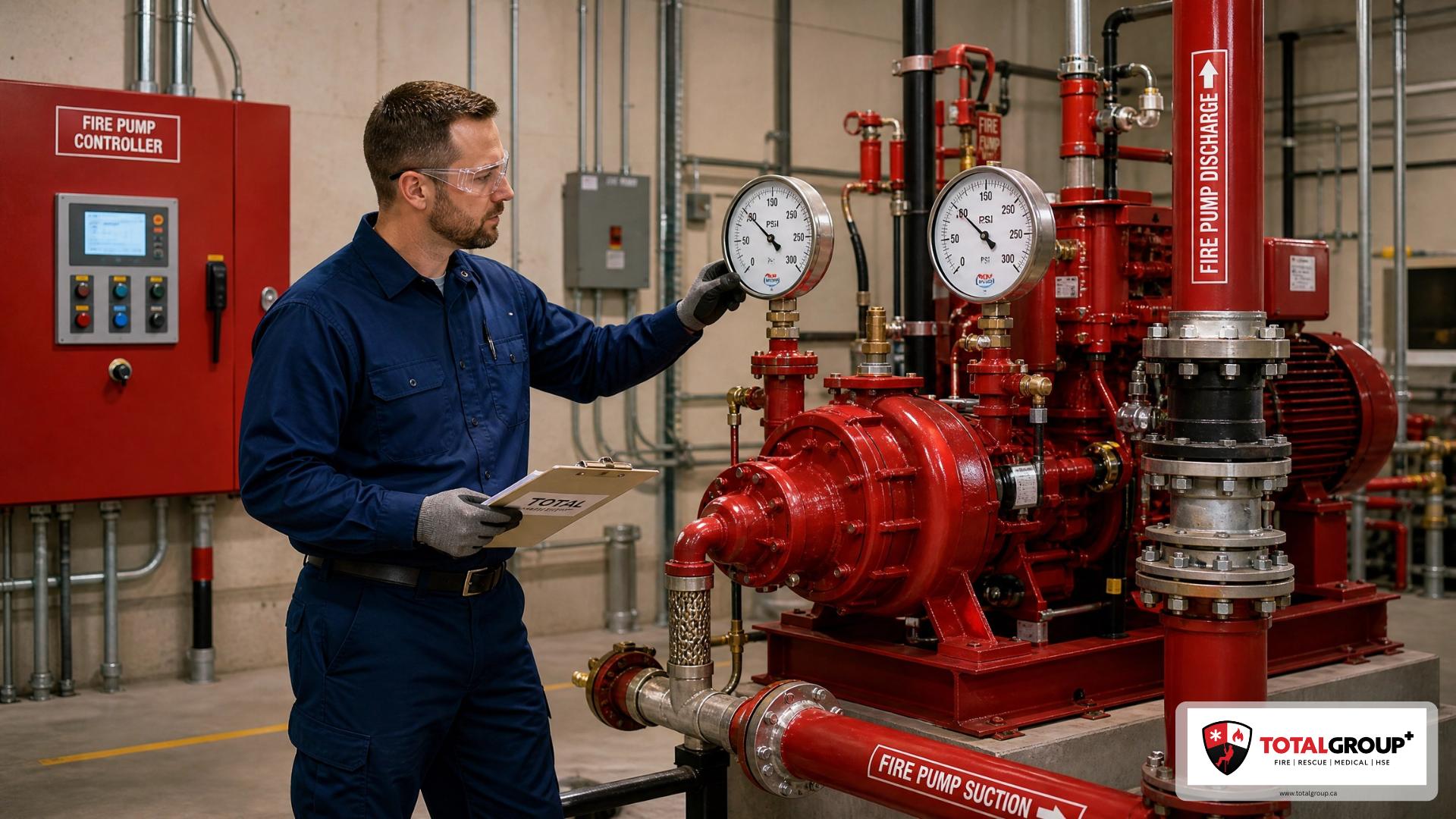
During the test, use the procedure approved for the installation. NFPA’s 2022 public guidance identifies observations such as suction and discharge pressure gauge readings, start pressure, unusual noise or vibration, excessive heat, controller information where available, and driver-specific conditions. Read controller information only where it is available without opening an energized motor-driven controller. For a diesel-driven unit, for example, the procedure can include observing crank time, running speed, oil pressure, temperatures, and cooling-water flow. The same source states that qualified personnel must attend while the pump is operating unless automated inspection and testing is performed in accordance with NFPA 25.[3]
Record more than a pass or fail mark. A good record shows what was observed and whether it matched the expected condition for that pump. If a reading is outside the expected range, if the pump does not start automatically, or if vibration, leakage, heat, or controller indications are abnormal, record the condition clearly and assign it for review. Do not adjust setpoints, defeat safeguards, or return a questionable pump to normal status without the authorized process for the site.
Why is flow testing different from a no-flow test?
A no-flow test helps verify starting and running behaviour, but it does not replace a flow test. NFPA’s cited public guidance describes annual flow testing to further verify the operating condition of a fire pump.[3] The exact method, connections, discharge arrangement, safety controls, and acceptance criteria depend on the installed system and the requirements that govern it.
Plan flow testing as a controlled maintenance activity. Review the approved test arrangement, discharge path, drainage, environmental controls, communications, and effect on operations before work begins. If the test could impair the fire protection system, follow the site’s impairment process and confirm how the system will be returned to service afterward.
Keep the result in context. Compare readings and observations with the documented information for that pump, including prior test data and available acceptance or commissioning records. A single number without its pump rating, test configuration, gauge condition, and prior record is difficult to interpret. Trends are more useful when each test is documented consistently.
What maintenance matters between scheduled tests?
Routine maintenance should be driven by the equipment documentation and the applicable inspection and maintenance program. The goal is to identify conditions that could affect availability before the next formal test. That can include maintaining clear access to the pump room, checking for visible leakage or damage, reviewing controller status and event information where available, and looking for changed site conditions that could affect the water supply or test setup.
A practical review can include the driver, controller, sensing line, suction and discharge connections, relief or circulation arrangements, valves identified in the procedure, drainage, and the records that establish the expected operating condition. If work affects any of those items, record what changed and how the fire protection system was restored.
Maintenance is also a communication task. Production, maintenance, security, emergency response personnel, and outside service providers need a clear view of when testing is planned, what protection remains available during the work, and who can authorize return to service. The details belong in the facility’s approved process, not in a generic checklist copied from another site.
What should the test record contain?
A usable test record tells the next reviewer what happened, when it happened, what equipment was involved, what was measured, and what was done about an exception. A practical record should include the test date and time, equipment identification, test type, readings and observations required by the approved procedure, people present, deficiencies found, corrective action owner, and the confirmation that the system was returned to its intended status.
Record retention is a legal requirement in some jurisdictions, and the details vary. Ontario’s Fire Code, for example, requires records of required tests and corrective measures or operational procedures to state what was done and the date and time. Subject to its lifetime-retention rule, records must be kept at the building for at least two years after preparation and so that the most recent and immediately preceding record of a given test or inspection are retained. Initial verification or test reports for fire protection systems installed after November 21, 2007 must be retained for the life of the systems.[4] That example should not be treated as a universal retention rule. Confirm the requirement for the location and occupancy of the building.
Link the corrective-action log to the test record. State the deficiency plainly, assign an owner and due date, capture interim precautions if they are authorized, and document the final verification. That creates an evidence trail from observation to closure and gives the facility team a clearer basis for the next review.
How can a facility make testing less disruptive?
Start with an annual planning conversation rather than a last-minute service request. Identify high-production periods, planned shutdowns, site access constraints, discharge and drainage limitations, and the people who must be notified. Confirm the records and drawings needed for the work before the appointment. This does not reduce the technical requirements, but it can prevent avoidable delays and make the work easier to coordinate.
Use the same closeout questions every time: Did the pump start as intended? Were the required readings recorded? Were any conditions outside the expected range? Is there an open corrective action? Has the system been restored, and have the right people been notified?
Discuss your industrial fire and safety requirements.
Frequently asked questions
How often should a fire pump be tested?
The answer depends on the equipment and the requirements that apply to the facility. NFPA’s 2022 public guidance describes weekly or monthly no-flow testing under NFPA 25, depending on the pump type, driver, and certain risk-analysis allowances, plus annual flow testing. Confirm the locally adopted code, the applicable standard edition, and the approved site procedure before setting the interval.[3]
Can the facility maintenance team perform the test?
Assign work only to people who are qualified for the procedure and equipment involved. NFPA’s 2022 public guidance states that qualified personnel must be in attendance while a fire pump operates, except where automated inspection and testing is performed in accordance with NFPA 25. It describes qualified personnel as competent and capable people who have met the requirements and training for the field acceptable to the authority having jurisdiction. The facility should also follow its own authorization, safety, and impairment procedures.[3]
What should happen if the pump does not start automatically or a reading is abnormal?
Document the condition, notify the responsible person under the site procedure, and determine whether the condition creates an impairment. Do not rely on a later test to resolve the issue. The response, interim precautions, corrective work, and confirmation of return to service should be recorded according to the facility’s approved process and applicable requirements.
Do electronic records count?
They can, where the governing rules permit them and the records can be made available as required. Ontario’s Fire Code expressly recognizes electronic records that can be readily provided to the Chief Fire Official on request.[4] Check the rule that applies to the building before relying on a digital-only record system.
Sources
- NFPA 20: Standard for the Installation of Stationary Pumps for Fire Protection.
- NFPA 25: Standard for the Inspection, Testing, and Maintenance of Water-Based Fire Protection Systems.
- NFPA, Weekly or Monthly No Flow Churn Tests of Fire Pumps, 2022 public guidance.
- Ontario Regulation 213/07, Fire Code, Division B, Articles 1.1.2.1–1.1.2.2, 6.6.1.5 and Subsection 6.6.3.